

The Complete Guide to Farmers Markets
What to buy, what to skip, food safety, prices, certifications, and how to find growers worth coming back to
Farmers' markets are one of the nicest ways to bring fresh, seasonal food into the kitchen while supporting the people who grow it. They also have a way of turning a simple shopping trip into something you look forward to — music in the background, flowers near the entrance, and tables full of produce that still look like they came from a field rather than a warehouse.
Here in the San Diego area, we're fortunate to have markets nearly every day of the week. They are not all the same, either. The vendors, food, plants, and atmosphere can change from one neighborhood to the next, which gives you a good reason to visit more than one.
What follows is everything I've picked up walking these markets — what's worth buying, what's worth asking, what the labels actually mean, and the handful of things I've learned to walk past.

How to Find Markets Near You
Our Farmers Market Finder is the fastest way to find a farmers market near you, listing markets by ZIP code along with their season and hours. County and city websites usually maintain their own lists, and most markets now post weekly updates on social media that tell you which growers will be there and what's coming in.
One thing worth knowing before you head out: not every market operates the same way, and in California, the difference has a legal definition.

What "Certified Farmers Market" Actually Means
In California, a Certified Farmers Market is a registered thing, not a friendly description. Only the producer, or a lawfully authorized representative of that producer, may sell in the certified section of the market. You'll also see a banner showing the farm's name, the county where the crops are grown, and what's being sold.
Growers get there by obtaining a Certified Producer Certificate from their county Agricultural Commissioner, and the Commissioner works with the California Department of Food and Agriculture to inspect producers and markets and verify the origin of the produce. Inspectors do show up. Buying wholesale produce and reselling it in the certified area is not allowed.

A few things this is worth knowing about
Are Farmers' Market Vegetables Safe?
It didn't take long to realize that the stand itself doesn't make produce safer or riskier. What matters is what happened before the vegetables reached the table — the water used on the farm, how the crop was harvested, how it was stored, and how it is handled once you bring it home.
One thing I've come to appreciate is how fresh the produce can be. Some growers harvested it the day before, while others were out in the fields the same morning. That's hard to beat, and you can often taste the difference. Even so, my routine never really changes. Vegetables from the farmers market get the same care as the ones I pick from the garden. They all get a good rinse before dinner.

A simple produce routine
- Pass on produce that is moldy, rotten, badly bruised, or leaking.
- Keep pre-cut produce, eggs, dairy, meat, and seafood cold on the way home.
- Wash your hands before preparing your farmers' market fruits and veggies.
- Rinse well, but soap and detergent do not belong on produce.
- Give firm produce, such as cucumbers and melons, a scrub with a clean produce brush.
- Keep your produce away from raw meats, poultry, and seafood in your bags and kitchen.
- Rinse the outside of melons and winter squash before cutting, since the knife carries whatever is on the rind straight into the flesh.
I handle produce from the market much the same way I handle vegetables from my own garden. A little soil on a carrot doesn't bother me, but it still gets rinsed before it reaches the cutting board.
Can You Get Cyclospora From Farmers Market Produce?
Yes, it is possible, just as it is with produce sold elsewhere. Cyclospora is a microscopic parasite that can sometimes contaminate fresh food or water, usually through poor sanitation. or water contaminated with feces, and outbreaks in the United States have been linked to several kinds of fresh produce.
Rinsing your fruits and vegetables with water is still worthwhile and is recommended by the CDC and FDA, but washing may not remove every organism. No vendor — and no supermarket — can honestly promise that raw produce is completely free of risk.
You may have seen Cyclospora in the news recently. During the summer of 2026, health officials investigated a large multistate outbreak linked to shredded iceberg lettuce that was recalled by a major commercial distributor.
What stood out to me was that this wasn't connected to your local farmers' market. It involved a large commercial supply chain. It's a good reminder that fresh produce can carry risks no matter where you buy it, which is why I still rinse fruits and vegetables and keep an eye on food recalls before bringing them to the table.
It didn't take long to realize that buying vegetables was only part of the visit. I'd stop to ask about an unfamiliar tomato or a bunch of herbs, and before long, I was learning why one variety tasted sweeter than another or what had been picked that morning. Those conversations are among my favorite parts of visiting the market.

Are Farmers' Markets More Expensive?
I used to assume farmers' markets were always more expensive. After visiting enough of them, I realized the answer depends on the season, the crop, the neighborhood, and which grocery store you're comparing it with.
Most small farms cannot compete head-to-head with a discount chain. But that's not really why we go to a farmers' market in the first place. Specialty mushrooms, pasture-raised meat, artisan cheese, baked goods, and prepared foods often cost more than the mass-produced versions.
Where the Value often shows up
| What you are buying | What to consider |
|---|---|
| Peak-season produce | is often the best place to compare prices, freshness, flavor, and variety. |
| Unusual varieties. | You may pay a little more, but these are often crops supermarkets do not carry. |
| Prepared and artisan foods | are usually priced for small-batch production and high-quality ingredients rather than bargain shopping. |
| Plants and starts | Value depends on plant health, pot size, variety, and whether the seller can offer useful growing advice. |
| Eggs, meat, and dairy | are rarely the cheap option, but you can ask exactly how the animals were raised and fed. |
| Seconds and bulk boxes. | The best deal at the market is if you're canning, freezing, or cooking it down that week. |


That last row is one I wish I'd caught on to sooner. Many growers keep a box of "seconds" behind the table — fruit that split, tomatoes with a scar, peppers that grew a little strange. It's the same crop at a lower price, and for sauce, salsa, jam, or the freezer, the shape never mattered anyway. You usually have to ask.
How to Pay, and How to Stretch What You Spend
I have noticed that most vendors, even the small farms, now take credit cards or a phone tap, but coverage at a market can be spotty, so I always carry cash in case.
Two things worth knowing if food budgets are tight:
CalFresh EBT
CalFresh EBT is accepted at many California markets, usually through the market's info booth rather than at each stand. You swipe once and receive tokens or scrip to spend with the growers.
Market Match
Market Match doubles those dollars, up to a daily limit, for fruits and vegetables. The program matches CalFresh benefits dollar-for-dollar up to a set maximum per market day, and it's run by the Ecology Center with funding from CDFA and the USDA. In 2025, it reached more than 600,000 shoppers across 303 market locations in 38 states. Funding has been uncertain from year to year, so the daily match amount and whether a given market offers it can change. The info booth will know.

Every Farmers' Market Has Its Own Personality
After visiting enough markets, you start looking forward to each one for a different reason. That's certainly been true around San Diego, where there are enough weekly markets to keep the calendar full.
The Solana Beach Farmers Market has become a favorite stop for its frozen wood-fired pizzas. The Cardiff market has a different rhythm, with good live music and plant vendors carrying unusual indoor and outdoor plants. Some markets shine because of their produce growers. Others are worth the trip for bread, mushrooms, flowers, honey, food stalls, or simply the easygoing crowd.


What You May Find That Supermarkets Rarely Carry
One of the best parts of farmers' markets is the variety. Grocery stores need fruits and vegetables that can be packed, shipped, stacked, and left on display. Local growers have more room to choose crops for flavor, color, curiosity, or simply because they enjoy growing something different.
Tomatoes make the point better than almost anything else. Instead of one or two standard red varieties, a summer table may hold Cherokee Purple, Brandywine, Green Zebra, Pineapple, Costoluto, and little Sungolds that have a habit of disappearing before they reach the kitchen.

- Pluots and apriums with a mix of plum and apricot traits.
- Watermelon radishes, purple carrots, lemon cucumbers, and Romanesco.
- Garlic scapes, fresh shelling beans, specialty peppers, and uncommon herbs.
- Small-farm mushrooms, freshly milled grains, local honey, and seasonal preserves.
- Vegetable starts, fruit trees, succulents, houseplants, native plants, and cut flowers.
Now and then, something unfamiliar catches my eye. That usually leads to a conversation, then a taste, and sometimes a search for seeds so I can try growing it myself. The market fills the refrigerator, but it has a way of filling the garden with new ideas too.
Shopping With the Season Instead of Against It
One trick I've picked up over the years is to look for the biggest stacks of produce first. When growers have tables overflowing with tomatoes, peaches, peppers, or squash, it's usually because the season is in full swing. That's often when prices are at their best, too. A small basket doesn't necessarily mean something is better—it often just means it's early, late, or there wasn't much to harvest that week.
Southern California blurs the calendar a bit compared with most of the country, since something is always coming in. Even so, the rhythm is there once you start noticing it.
What tends to show up

What tends to show up

What tends to show up

What tends to show up

How to Choose a Produce Vendor
Good produce doesn't need to look perfect. Real farm produce can be lumpy, dusty, small, oversized, or a little scarred. What matters is that it looks fresh, has been handled with care, and is being sold by someone who can tell you what it is and where it came from.

Some Green flags
- The produce looks fresh for the crop: crisp greens, fragrant herbs, sound fruit, and no spreading mold or decay.
- Prices and product names are easy to find.
- Cold foods are kept cold and protected from direct sunlight.
- The vendor knows the varieties, harvest timing, storage needs, and growing methods.
- Claims such as organic or Biodynamic are clearly stated and supported when certification is required.
- The selection changes with the season, which is a quiet sign the produce is coming off a working farm.
Questions worth asking
I will ask if the produce looks too perfect.
Most vendors will say it was harvested yesterday or even that morning.
I like this question the best, because then I can search for seeds of my favorite newfound fruit or veggie. I just ordered Costoluto Florentino tomatoes after asking this question.
They will sometimes dig out the prize fruit they had set aside for you.
I usually start with one simple question. It might be about a tomato I've never seen before or what's tasting its best that week. Before long, we're talking about the season, favorite varieties, or what's almost ready to harvest. More than once I've walked away with a new gardening idea—or something delicious that wasn't on my shopping list.
Red Flags and Things I've Learned to Walk Past
Most vendors are exactly what they appear to be. Still, a few patterns have taught me to slow down and look a little closer.


Signs that the produce may not have come from that farm
- Everything is available year-round in the same quantities. Farms have seasons. A stand carrying bananas, pineapple, and out-of-region fruit alongside its vegetables is buying at least some of it wholesale.
- The produce is uniformly sized and waxed, sitting in printed wholesale cartons with a distributor's name on the side. Field-run produce rarely matches that neatly.
- Vague answers about the farm. "It's from a farm up north" is not an answer. A grower can name the county, the field, and roughly when it was picked.
- No farm banner in a certified market. In California, that banner is required in the certified section, and its absence is worth noticing.
- Prices are well below every other stand at the market—growing costs what it costs. A stand undercutting everyone by half is usually reselling.
Reselling isn't always dishonest, and some markets openly allow it outside the certified area. What bothers me is a reseller telling you they grew it.
Handling and food-safety warning signs
- Cut fruit, eggs, dairy, or meat sitting out in the sun without ice or a working cooler.
- Samples left open and unattended, with no clean utensil and no cover.
- Mold that has clearly spread through a display rather than showing up on a stray piece.
- Greens wilting in full sun with no shade cloth or misting.
- Nobody washes their hands or changes gloves between money and food.
I take claims with a grain of salt.
- "Spray-free," "natural," "chemical-free," and "beyond organic" have no regulated meaning. They may describe a careful farm. They may describe nothing at all. Ask what the grower actually does.
- "Local honey cures allergies." It's a pleasant idea, and the evidence for it is thin. Buy local honey because it tastes better and supports a beekeeper.
- "Organic" without certification on a stand large enough to require it. Small operations below the federal sales threshold can be exempt, so this one calls for a question rather than a verdict.
- Anything sold as a cure. A market is not a pharmacy.
Things I avoid buying for practical reasons
- Anything perishable at the beginning of a long morning of errands.
- Delicate berries at the end of a hot day, when they've had hours to soften.
- More greens than the refrigerator can honestly hold, which I still do occasionally and still regret.
- Prepared foods without a visible label, if I'm going to keep them for a few days. In California, home-kitchen goods are legal to sell at certified markets under the cottage food rules, and the label must include the business name and address, the ingredients, and the words "Made in a Home Kitchen." A proper label is a good sign, not a warning.
Beyond Produce: Eggs, Meat, Bread, Honey, and Flowers
Most people arrive for vegetables and leave with half a kitchen. Each of these tables rewards slightly different attention.


They should be cold and stay cold on the way home. Ask about the flock — how many birds, what they're fed, and how much time they spend outside. Shell color says nothing about quality and everything about the breed of hen. Yolk color mostly reflects diet.
These have to be sold frozen or held cold, and a serious vendor will have a real freezer or a well-packed cooler rather than a picnic chest. Worth asking: where the animals were raised, where they were processed, and whether terms like pasture-raised or grass-finished describe the whole life of the animal or just the end of it.
Ask whether it's pasteurized, especially if you're feeding someone in a higher-risk group. Aged cheeses hold up better on a warm morning than fresh ones.
Ask when it was baked. Real sourdough will have an open, irregular crumb and a firm crust, and it stales rather than staying soft for a week. Bread is one of the few things at a market I'll happily buy at the end of the day.
Local, raw, unfiltered honey crystallizes over time, and that's a sign of the real thing rather than a flaw. Gentle warming brings it back. Ask where the hives are and what the bees were working on, because the flowers change the flavor completely. In California, honey is a certifiable agricultural product, which means a beekeeper can carry it on a Certified Producer Certificate.
Look for buds just beginning to open rather than blooms at their peak. Ask the grower to recut the stems, get them into water quickly, and keep the bunch out of the sun on the drive home.
Buying Plants and Seeds at the Market
This is the part of the market I have the hardest time walking past. Plant vendors often carry varieties no garden center bothers with, and the person selling them usually grew them nearby, which means they're already used to your weather.

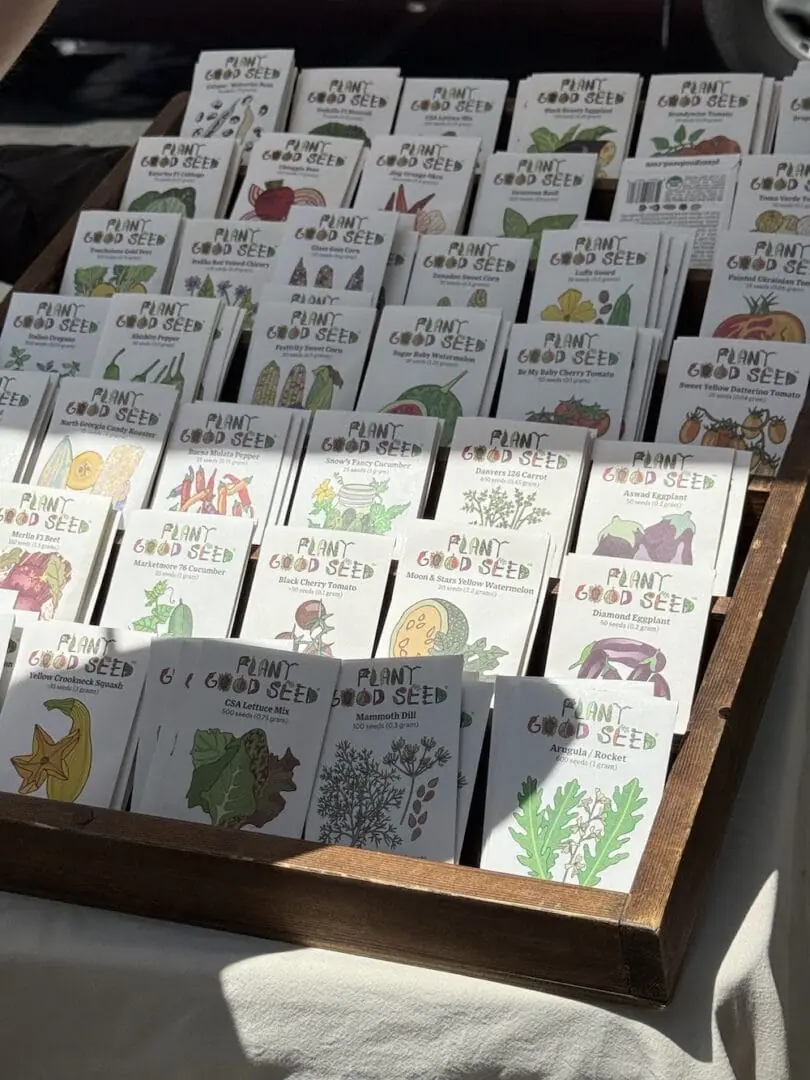
What to look for
What the Certifications Mean
USDA Organic.
I never really thought much about what the USDA Organic label meant until I started talking with growers. It isn't just a marketing term. Farms certified under the program must meet federal organic standards and be inspected by a USDA-accredited certifier. Organic also doesn't mean pesticide-free. It means the farm follows strict rules about the materials and practices it can use. Some very small farms are exempt from certification because of their size, even though they may use the same organic methods.
Certified Naturally Grown.
Smaller farms often use a separate private certification. Its crop standards are built on organic practices and a peer-review inspection model. It is not the USDA Organic program, even though the farming principles can overlap.
Demeter Certified Biodynamic.
Used for Biodynamic farms. The standard considers the farm as a whole system, including soil fertility, biodiversity, livestock and crop practices, and other farm management requirements. In the United States, the Biodynamic certification marks are administered by Demeter USA.
The first place I usually look is the banner hanging behind the booth.
Their banner is where most growers proudly display certifications like Organic, USDA Organic Certified Grown Naturally, or my favorite, Biodynamic, making their certifications easy to spot before you even start asking questions. Then I start asking questions. I always enjoy hearing how they grow their crops, what varieties they're excited about, and what's tasting its best that week.

A Few Habits That Make Market Mornings Better
Keep reusable bags and a small cooler in the car. Walk the market once before filling your hands, and ask a grower what is best that morning. The tomatoes aren't going anywhere, and some of the best finds are usually a few booths farther down.

Your Market Day Checklist
0 of 7A word on etiquette, since it makes the whole morning run more smoothly. Ask before handling delicate fruit, and let the grower pick the peaches. Haggling over a fair price at nine in the morning isn't really done, though asking about a bulk price or a box of seconds is completely normal. Keep traffic flow in mind at a crowded stand, and if a vendor is mid-transaction, the growing question can wait 90 seconds. Nobody minds the question. They mind it landing in the middle of somebody's checkout.
Getting It Home and Keeping It
Market produce was picked closer to ripe, which is exactly why it doesn't behave like the grocery store version. Half the Value of the trip disappears in the refrigerator drawer if you treat it the same way.
Leave it on the counter, not in the cold.
Tomatoes lose their flavor and turn mealy below about 55°F, so they stay out until they're cut. Basil sulks in the refrigerator and turns black at the edges; a cup of water on the counter suits it far better. Peaches, plums, nectarines, melons, and avocados all finish ripening at room temperature and can be moved to the refrigerator once they're where you want them. Onions, garlic, potatoes, and winter squash need a dark, dry, cool spot, with the potatoes kept away from the onions.

Refrigerate, with a little help
Leafy greens and herbs like cilantro and parsley last far longer standing in a jar of water with a loose bag over the top. Carrots, beets, and radishes should have their tops trimmed off before they go in, because the leaves can pull moisture from the roots. Berries stay unwashed until the moment you eat them, since water on the skin invites mold. Corn, peas, and asparagus start converting sugar to starch the hour they're picked, so those get eaten first.

One more thing that quietly matters: apples, pears, and bananas give off ethylene gas, which can ripen your produce, like avocados, whether it's ready or not. Keeping them away from leafy greens buys you several extra days.
Everything I bring home now gets sorted on the counter before it's put away, which takes about 4 minutes and has saved more produce than any other habit I've picked up.
Bringing the Market Back to the Garden
Every so often, something from the market ends up in the ground rather than the kitchen. Garlic bought from a grower can be broken into cloves and planted in the fall. Potatoes with eyes will grow, though seed potatoes are cleaner and less likely to carry disease. Dry beans from a bulk bin often sprout perfectly well.

Saving seed from market tomatoes and peppers works, with one caveat worth knowing. Heirloom varieties come back true, so a Cherokee Purple grown from saved seed gives you Cherokee Purple. Hybrids, including Sungold and most of the reliable supermarket types, are crosses, and their seeds produce unpredictable results — sometimes interesting, rarely the same. If the grower can name the variety, they can usually tell you which one you're holding.
That's a big part of why the plant stand and the produce table feel connected to me. A tomato that tastes like something on a Saturday morning has a way of ending up on a trellis the following spring.
Common Questions
No. Some vendors are certified organic, some follow organic practices without certification, and some use conventional methods. Local and organic are two separate things, and only one of them has a legal definition.
In a certified market's produce section, it has to come from the farm on the banner. Outside that, it depends on the market's rules. Asking is the only reliable way to know.
Usually, yes — market produce is often picked within a day or two rather than shipped and stored. That freshness is also why it needs to be used sooner.
Yes. Organic certification governs how a crop is grown, not what settles on it afterward. Everything gets a rinse.
Early for selection, late for occasional deals. If you want a real conversation with a grower, avoid the first twenty minutes and the final rush.
Depends entirely on the market, and rules have tightened in many places over the years. I have not found a market that would let me bring in my Rhodesian Ridgeback. Check the market's website before you load up the car.
- U.S. Food and Drug Administration, Selecting and Serving Produce Safely.
- U.S. Food and Drug Administration, 7 Tips for Cleaning Fruits and Vegetables.
- U.S. Food and Drug Administration, Raw Milk and Juice HACCP consumer guidance.
- Centers for Disease Control and Prevention, Preventing Cyclosporiasis and About Cyclosporiasis.
- The Centers for Disease Control and Prevention, Food Safety guidance on raw sprouts and unpasteurized products.
- USDA Agricultural Marketing Service, National Organic Program, and Organic Certification.
- USDA Agricultural Marketing Service, Local Food Directories: National Farmers Market Directory.
- California Department of Food and Agriculture, The Certified Farmers' Markets and Direct Marketing Program.
- California Code of Regulations, Title 3, Direct Marketing regulations governing Certified Producer Certificates.
- California Department of Public Health, Cottage Food Operations, and approved cottage foods list.
- County of San Diego Department of Environmental Health, Cottage Food Label Requirements.
- The Ecology Center, Market Match program information.
- Demeter USA, Biodynamic Certification and Farm Standards.
- Certified Naturally Grown, certification standards, and program information.