
Garden Archways and Portals
 Written by
Garden Decor
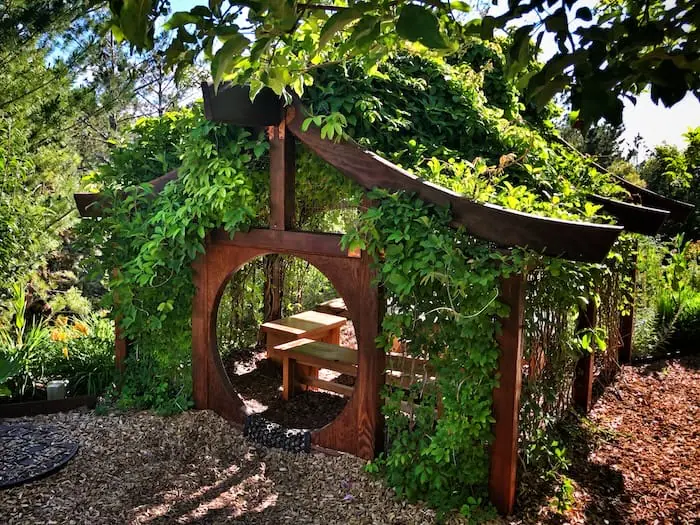
How Garden Archways Can Change the Way Your Garden Feels
If you’ve ever walked through vine-covered garden archways and felt your shoulders drop without knowing why, you already understand the trick. It’s not necessarily expensive. It doesn’t have to be complicated. But it changes everything.
Most gardens grow outward. Beds along fences. Rows. Corners filled in over time. An arch makes your garden grow inward. It pulls you through. And once you see what that does to a space, you can’t unsee it.

My husband and I put our first arch up almost on a whim. I thought it would just hold up a climbing rose. What it really did was create a doorway to the front of our home, and that didn’t quite exist before.
And that’s when I got hooked on creating portals.
A Garden Feels Different When It Has a Threshold
There’s something about stepping through an opening that shifts your mood. Even if it’s just two cattle panels bent into a curve and wired to t-posts. The brain likes transitions. Portals can be as simple or as complex as you want.
Why crossing under or through something matters

An arch creates a pause. A door or portal creates a new room, even if it leads nowhere!
You step under it, or through it, and, for a second, you’re aware you’re entering somewhere. It’s subtle, but it’s powerful. Kids feel it immediately. They slow down. They peek through before walking in. Adults pretend not to care, but they feel it too.
An arch, a portal, they are different. They give you that sense of movement and draw you in to explore.
It’s the extra something special in a garden.
Vines Turn Wood and Metal Into Something Alive
Bare arches are fine. Functional. But once vines take hold, the whole thing softens.
I’ve grown climbing roses, pole beans, scarlet runner beans, and even cucumbers over arches. I admire anyone willing to try hops. I love beer, and the thought is pretty cool, but maybe too ambitious for me because I am pretty sure they would take off like they were trying to leave the property.
What to look for when choosing climbers
Not all vines behave the same.
Some wrap gently. Some grab. Some strangle. According to Utah State University Extension, wisteria is beautiful but its vigorous growth can overwhelm lighter garden structures if not kept in check. Morning glories may appear delicate, but they can quickly reseed themselves and spread into every available space.

I lean toward plants that give more than one gift. Beans feed you. Grapes shade you and feed you. Climbing roses bring pollinators in close. I like it when structure and ecosystem meet in the middle.
That’s probably the tree planter in me. I’m always thinking long term. How does this support birds? Bees? Soil life below it?
An arch isn’t just decoration. It can be a habitat.
Creating “Rooms” Without Walls
Small yards benefit the most from arches. They break space into sections without blocking light.
One arch can divide a vegetable garden from a sitting area. Two arches in a row can make a tunnel. I can definitely imagine building a narrow cattle-panel tunnel and letting loofah gourds climb over it. By late summer, it would feel like walking through green lace.
When a portal becomes a tunnel
Here’s the part no one really explains. A portal is defined as a door, so if you open that door and create some depth, you suddenly have a tunnel!

When vines meet overhead, you don’t just have shade. You have an enclosure. It feels private. Almost like a secret garden.
I’ve seen neighbors walk through mine and immediately lower their voices. As if the plants are listening. And maybe they are.
We spend so much time trying to maximize production. Bigger harvest. More yield. But there’s something to be said for maximizing wonder. That sounds soft, I know. But gardens can be beautiful. They’re allowed to stir imagination.
Honestly, if you have kids or grandkids, give them an arch tunnel once and watch what happens. It becomes a fort, a fairy passage, a jungle path. Adults need that too. We just don’t admit it.
Practical Things I Learned the Hard Way
Anchor it better than you think you need to
Wind finds arches. Especially once vines add weight. Drive posts deep. Secure the base. Wet soil after heavy rain can loosen things fast.
I had one tilt mid-season under the weight of a vigorous squash experiment. It survived, but barely. Lesson learned.
The sun matters more than you think.
If the arch sits north-south, both sides get decent light. East-west orientation can leave one side sulking (but not always). That might be fine if you plan for shade lovers on one side, but don’t ignore it.
It’s funny how something vertical changes your light patterns. You don’t realize it until the beans on one side are thriving and the other side looks like it needs a pep talk.
The Science and the Soul of It
Research shows that gardens reduce stress and improve well-being. The USDA has long supported urban greening projects due to their measurable impact on communities and mental health. Universities like Cornell and UC Davis publish studies on how green spaces influence mood and even cognitive function.
I didn’t need a study to tell me that. But it’s nice to know the science backs up what we feel.
An arch is a small act of shaping space. But shaping space shapes experience and motivates imagination.
When I help plant trees in restoration projects, we talk about the canopy. Layers. Long-term vision. An arch is like a fast-forward button on that idea. It creates a canopy at eye level.
You walk under it, and you’re in a different place. Same yard. Different feeling.
It Doesn’t Have to Be Fancy But It Can Be

I’ve seen beautiful wooden pergola-style arches that look like they belong in a magazine. I’ve also seen bent livestock panels zip-tied to fence posts that feel just as magical once they’re covered in green.
Don’t wait for perfect. Use what you have and grow into it.
Gardening is booming right now because people want spaces that feel alive. Not just productive. Alive. And even seasoned gardeners are still experimenting, still adjusting, still chasing that feeling when a space finally clicks.
An arch might be that click of inspiration for you. Or it might just be the beginning of a brand new space to enjoy.
What are the best plants to grow over a garden arch?
How tall should a garden arch be?
Do arches work in small gardens?
Will an arch block too much sun from my vegetables?
Share this post
Table of Contents
- How Garden Archways Can Change the Way Your Garden Feels
- A Garden Feels Different When It Has a Threshold
- Why crossing under or through something matters
- Vines Turn Wood and Metal Into Something Alive
- What to look for when choosing climbers
- Creating “Rooms” Without Walls
- When a portal becomes a tunnel
- Practical Things I Learned the Hard Way
- Anchor it better than you think you need to
- The sun matters more than you think.
- The Science and the Soul of It
- It Doesn’t Have to Be Fancy But It Can Be
About the Author

Nicole Stark
Nicole started The Bright Garden after years of hands-on learning in her own backyard, where she fell in love with healthy soil, native plants, and gardening the natural way. She shares honest, experience-based tips and enjoys time outdoors — gardening, fishing, and slow living with family. Gardening style: Organic, a little wild, always evolving. Current favorites: Worm bins, pollinator plants, backyard dinners.
Interactive Guides




All categories
More From The Garden






Disclosure: This post may contain affiliate links. That means if you click and buy, The Bright Garden may earn a small commission, at no extra cost to you. We only recommend products we’ve vetted and believe will benefit our readers.